
What's In A Name

M.E. affects the brain and muscles as well as the digestive, immune, and cardiac systems. It's a complex illness, so why was it originally named for a symptom that is part of nearly every other disease? Chronic fatigue is symptom of many illnesses, and is different from Chronic Fatigue Syndrome. Just about everyone past puberty experiences fatigue, which is probably why a chronic illness called Chronic Fatigue Syndrome usually isn't taken seriously. It's like if heart attacks were called chest squeezeys.
Even worse M.E. was referred to as the Yuppie Flu in the 1980s. It wasn't taken seriously, so very little research has been done on it. A consequence of that lack of research is that there still aren't any known biomarkers. Without those biomarkers, it isn't taken seriously. And so goes the catch-22.
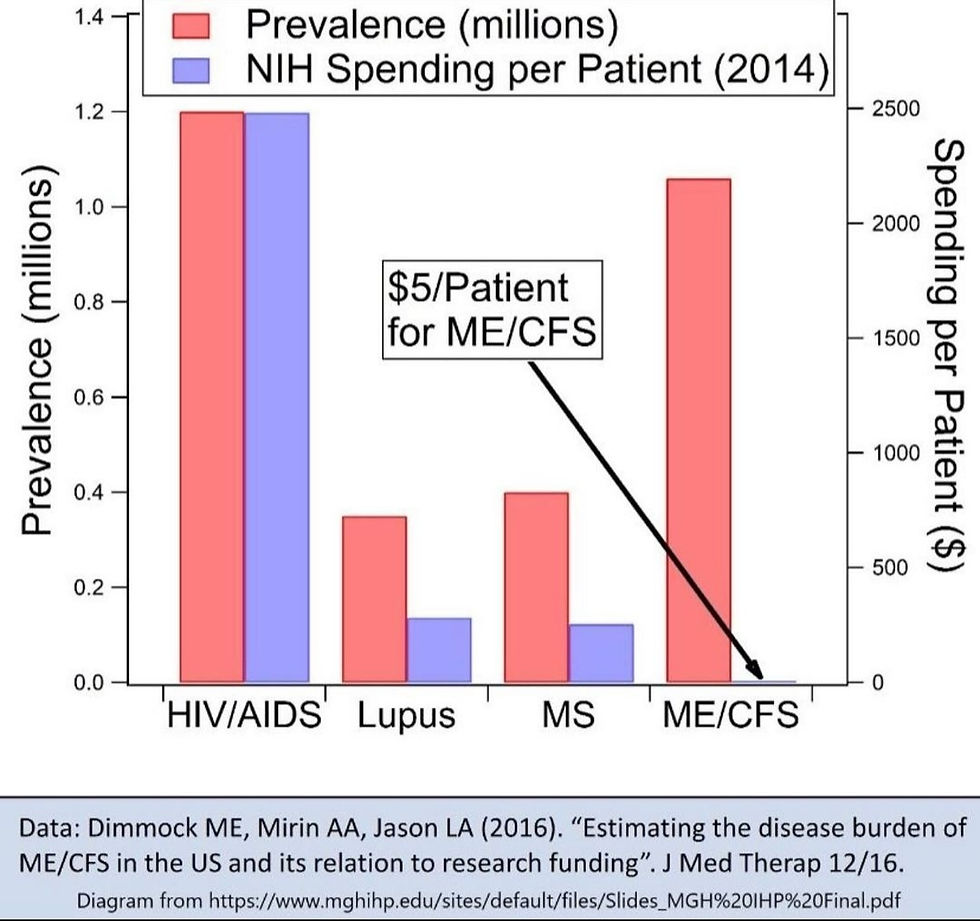
Above: research funding per patient, US 2014
Some researchers are hopeful that new funding for Long COVID research will provide new insights into M.E. Both diseases have a lot of overlapping symptoms, and are triggered by a virus. Unfortunately, some organisations are recommending that people with Long COVID try things that were found to be harmful to people with M.E., like graded exercise therapy¹. I'm no scientist, but if 2 things are that similar, don't expect that something harmful to one will help the other.
¹ a good resource to learn more about graded exercise therapy can be found at https://www.emerge.org.au/gradedexercisetherapyandmecfs
Comments